
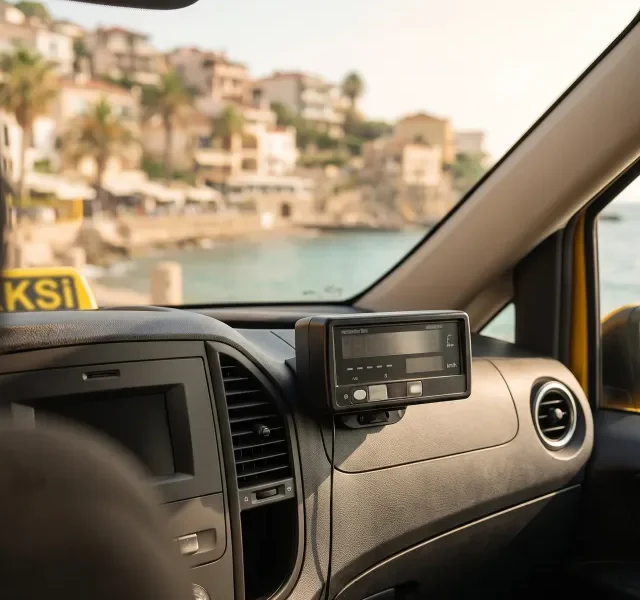
If you’re planning to take a taxi in Kusadasi — whether from the cruise port, your hotel, or anywhere else in town — it helps to understand how the fare is actually calculated before you get in the car. Taxi pricing in Kusadasi, like in the rest of Turkey, follows a structured system based on official meter rates rather than random negotiation. This article explains exactly how that system works, what affects the final price, and what to expect on a typical ride.
The Basic Structure: Meter-Based Pricing
Licensed taxis in Kusadasi operate on a taximeter system, which combines two main components:
- Opening fare (flag-down rate) — a fixed starting amount that appears on the meter the moment the ride begins.
- Distance-based rate — an additional charge calculated per kilometer traveled during the ride.
This means the final fare is essentially: opening fare + (distance traveled × per-kilometer rate). Unlike flat-rate systems used in some tourist areas, a metered taxi in Kusadasi reflects the actual distance and route taken, which is generally more transparent for the passenger.
Day Tariff vs. Night Tariff
Turkish taxi regulations, including those applied in Kusadasi, typically include two separate tariffs:
- Day tariff (Gündüz tarifesi): Applied during standard daytime hours, usually until midnight.
- Night tariff (Gece tarifesi): Applied late at night, usually from midnight until early morning, and priced at a higher rate — commonly around 50% more than the day rate.
This night surcharge is standard practice across Turkey and is not specific to tourists; local residents pay the same night rate. If you’re taking a taxi late in the evening, it’s normal to see a higher total than you would for the same distance during the day.
What Affects the Final Fare
Several factors influence how much a taxi ride in Kusadasi will cost:
- Distance traveled — the primary factor, since the meter calculates fare per kilometer.
- Time of day — day vs. night tariff, as explained above.
- Traffic and waiting time — most meters also include a small waiting charge for time spent stationary in traffic or at stops, calculated separately from the distance rate.
- Route taken — a direct route naturally costs less than a longer one; a driver familiar with the area will generally take the most efficient path.
- Additional stops — if you ask the driver to make an extra stop along the way, this adds both distance and time to the total fare.
Why the Meter Matters
Using the taximeter is the standard and expected practice in Kusadasi. A running meter protects both the passenger and the driver by keeping the fare tied directly to the actual distance and time of the ride, rather than a subjective or negotiated amount. When you get into a licensed taxi:
- The driver should start the meter at the beginning of the ride.
- The fare displayed at the end reflects the distance and time actually covered.
- Short local rides within Kusadasi center are generally inexpensive, while longer rides (for example, toward Ephesus or Selçuk) will show a higher total simply due to distance.
Fixed-Rate Routes
For certain well-known, frequently traveled routes — such as from Kusadasi Port to nearby landmarks — some taxi services offer a pre-agreed fixed price instead of relying solely on the meter. This is common for airport transfers or longer point-to-point routes where both the passenger and driver benefit from knowing the total cost in advance, without watching the meter climb during a longer drive.
When a fixed rate is offered, it’s usually based on the average metered cost for that specific distance, adjusted slightly to account for return travel or waiting time. Always confirm whether a quoted price is a fixed rate or a metered estimate before starting the ride, so there’s no confusion at drop-off.
Tips for a Transparent Taxi Experience in Kusadasi
- Confirm the tariff type — ask whether the day or night rate applies if you’re traveling close to midnight.
- Watch for the meter — a licensed taxi should always run the meter unless a fixed price has been agreed upon beforehand.
- Ask for an estimate for longer rides — for trips outside the town center, a driver can usually give you a rough estimate based on distance.
- Keep small bills handy — many local taxi rides are paid in cash, and having smaller denominations makes the transaction smoother.
- Choose licensed taxis — official taxis display visible licensing and use calibrated, regulated meters, ensuring the fare shown is accurate and fair.
Frequently Asked Questions
Is there a fixed starting fare for taxis in Kusadasi?
Yes, taxis start with an opening fare shown on the meter as soon as the ride begins, before any distance is added.
Are night taxi fares more expensive in Kusadasi?
Yes. Like the rest of Turkey, Kusadasi applies a higher night tariff, generally starting at midnight, which is typically around 50% higher than the daytime rate.
Do taxi fares in Kusadasi include waiting time?
Most meters include a separate charge for waiting time, such as time spent in traffic or stopped at a passenger’s request.
Can I get a fixed price instead of using the meter?
For certain common routes, a fixed price can be agreed upon in advance instead of relying on the meter, particularly for longer or frequently traveled trips.
How can I make sure I’m charged fairly?
Always ride with a licensed taxi that uses a running meter, and confirm in advance whether you’ll be charged by meter or a pre-agreed fixed rate.
Final Thoughts
Taxi fares in Kusadasi follow a clear, regulated meter system built around an opening fare, a per-kilometer rate, and separate day and night tariffs. Understanding these basics — along with knowing when a fixed rate might apply — makes it easy to know what to expect before you even get in the car, ensuring a transparent and predictable taxi experience.